

Discover how ServePremier’s Educational Model connects purpose, teaching, school culture, and systems around the learner, rooted in Fulton Science Academy’s experience.
By Dr. Kenan Sener, CEO, ServePremier Education
What connects a school’s mission to what a learner experiences on an ordinary Tuesday morning?
For school leaders, this is a practical question. A mission should help teachers plan meaningful learning, guide decisions about resources, and shape how adults respond when a student needs greater challenge or support. The connection between intention and experience requires deliberate design.
ServePremier Education’s newly articulated Educational Model makes those connections explicit. Rooted in the experience of Fulton Science Academy Private School, it brings together the beliefs, practices, relationships, and systems that support educational excellence and whole-learner development.
Rooted in practice, expressed with greater clarity
The framework draws on years of school development and educational practice at Fulton Science Academy. Our latest work gives that experience a clearer shared language, helping educators and school communities understand how its different elements work together.
As a nonprofit subsidiary wholly owned by Fulton Science Academy, ServePremier shares these principles through school management, educational consulting, and professional learning. Implementation responds thoughtfully to each school’s mission, learners, community, and local context.
Seven components connect purpose with practice
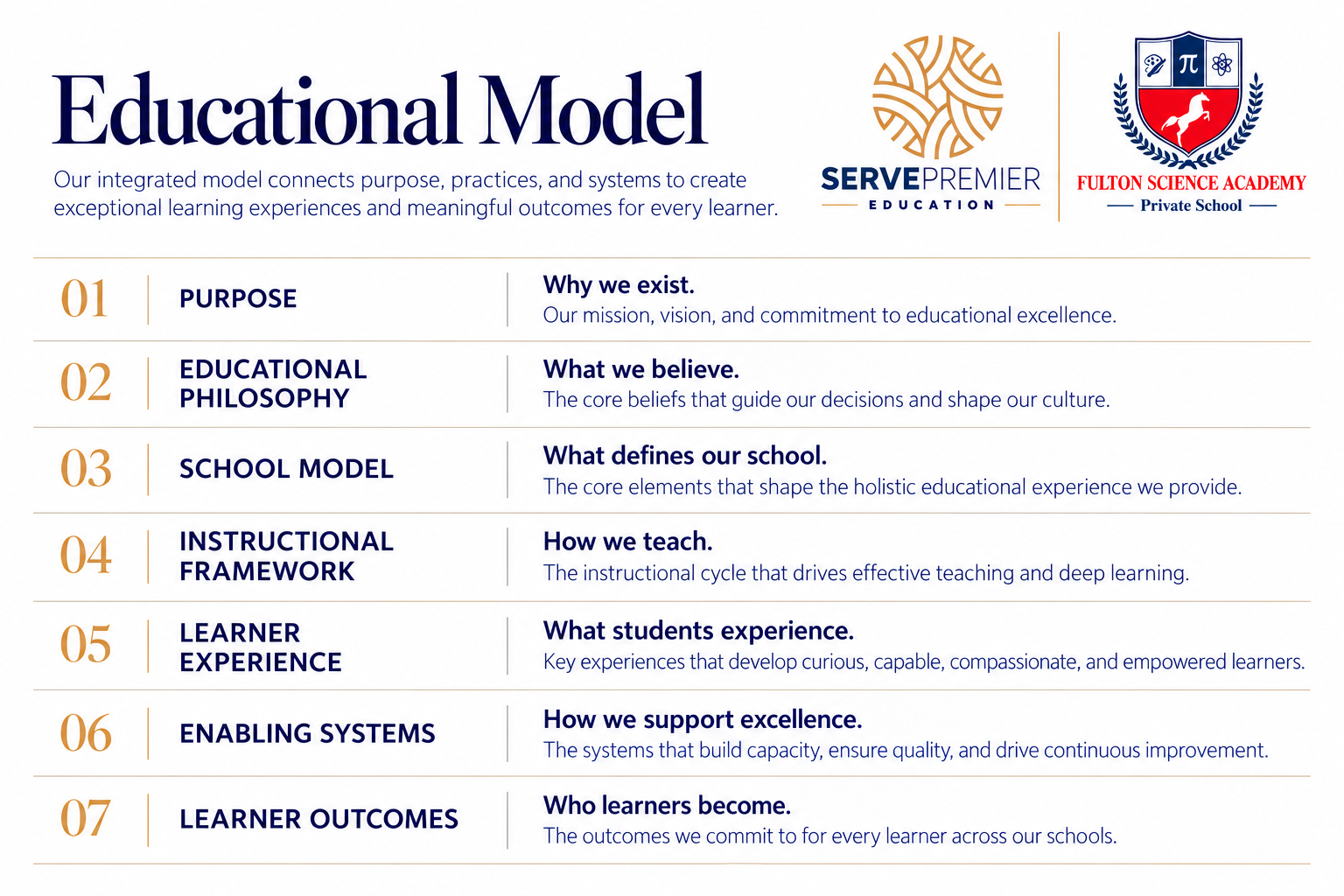
The Educational Model is our complete framework. Its seven components address seven connected questions:
- Purpose — Why we exist. Empowering learners to achieve excellence, serve others, and positively impact the world.
- Educational Philosophy — What we believe. Shared beliefs about learner potential, relationships, rigor, meaningful learning, character, and improvement.
- School Model — What defines our schools. Six interconnected educational pillars with the learner at the center.
- Instructional Framework — How we teach. Responsive practices that connect knowing each learner with rigorous learning, inquiry, application, feedback, and independence.
- Learner Experience — What learners experience. Commitments describing learning from the student’s perspective, including belonging, challenge, ownership, and opportunity.
- Enabling Systems — How we support excellence. The leadership, people, curriculum, resources, partnerships, and evidence that sustain the work.
- Learner Outcomes — Who learners become. The knowledge, capabilities, character, and readiness we intentionally seek to develop.
Together, these components help leaders examine whether everyday decisions support the educational experience they promise.
The School Model: the learner at the center
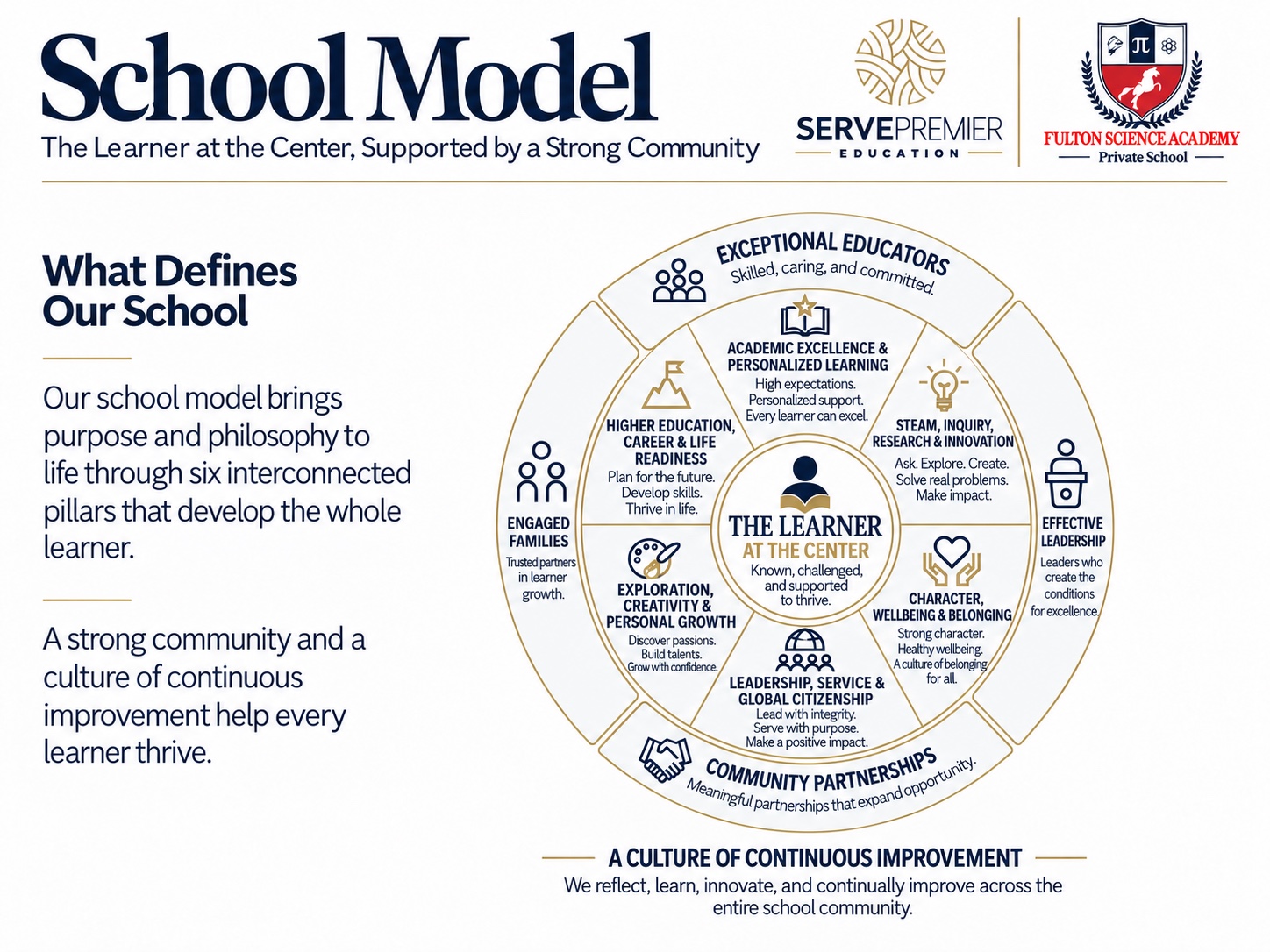
Within the broader Educational Model, the School Model describes six pillars of a connected learner experience:
- Academic Excellence & Personalized Learning
- STEAM, Inquiry, Research & Innovation
- Character, Wellbeing & Belonging
- Leadership, Service & Global Citizenship
- Exploration, Creativity & Personal Growth
- Higher Education, Career & Life Readiness
Exceptional educators, effective leadership, engaged families, and community partnerships support the whole model. Continuous improvement strengthens it over time.
The pillars reinforce one another. A research project, for example, can deepen academic understanding while developing collaboration, creativity, ethical judgment, and confidence. A service experience can connect classroom knowledge with leadership, empathy, and responsible contribution.
Character expressed through everyday choices
Our I CARE values—Integrity, Curiosity, Advocacy, Resiliency, and Empathy—give character a shared language. Their meaning becomes visible through honest work, thoughtful questions, responsible use of voice, persistence through setbacks, and care for others.
These values help connect academic learning with relationships and school culture. They inform how learners collaborate, respond to feedback, and contribute to their communities.
What coherence looks like in practice
Consider a classroom investigation. The teacher begins by understanding learners’ readiness and designing an appropriately challenging task. Students ask questions, examine evidence, explain their reasoning, and revise their work. Feedback helps the teacher adjust support while learners take increasing ownership.
That experience brings several components together: beliefs about rigor and responsiveness, the School Model’s emphasis on inquiry, instructional practices that guide feedback, and outcomes involving knowledge, judgment, and independence.
School systems must make such teaching possible through planning time, professional learning, aligned curriculum, and appropriate resources. Leaders can then ask: Are learners experiencing what we intend? What evidence helps us understand their growth? What should we improve?
A shared direction for school communities
One of the most important responsibilities of school leadership is ensuring that the school’s mission is recognizable in its classrooms, relationships, and everyday decisions. A framework becomes useful when it helps people make decisions, reflect honestly, and strengthen practice together.
The ServePremier Educational Model offers that shared direction while allowing thoughtful adaptation. Our aim is to help each learner pursue excellence with purpose and contribute meaningfully to others.
If you asked your teachers, students, and families what defines the learning experience at your school, how closely would their answers align?
Great schools are built through deliberate choices—and strengthened when those choices consistently serve the learner.
Explore the complete ServePremier Educational Model, or connect with our team to discuss how these principles could support your school community.