
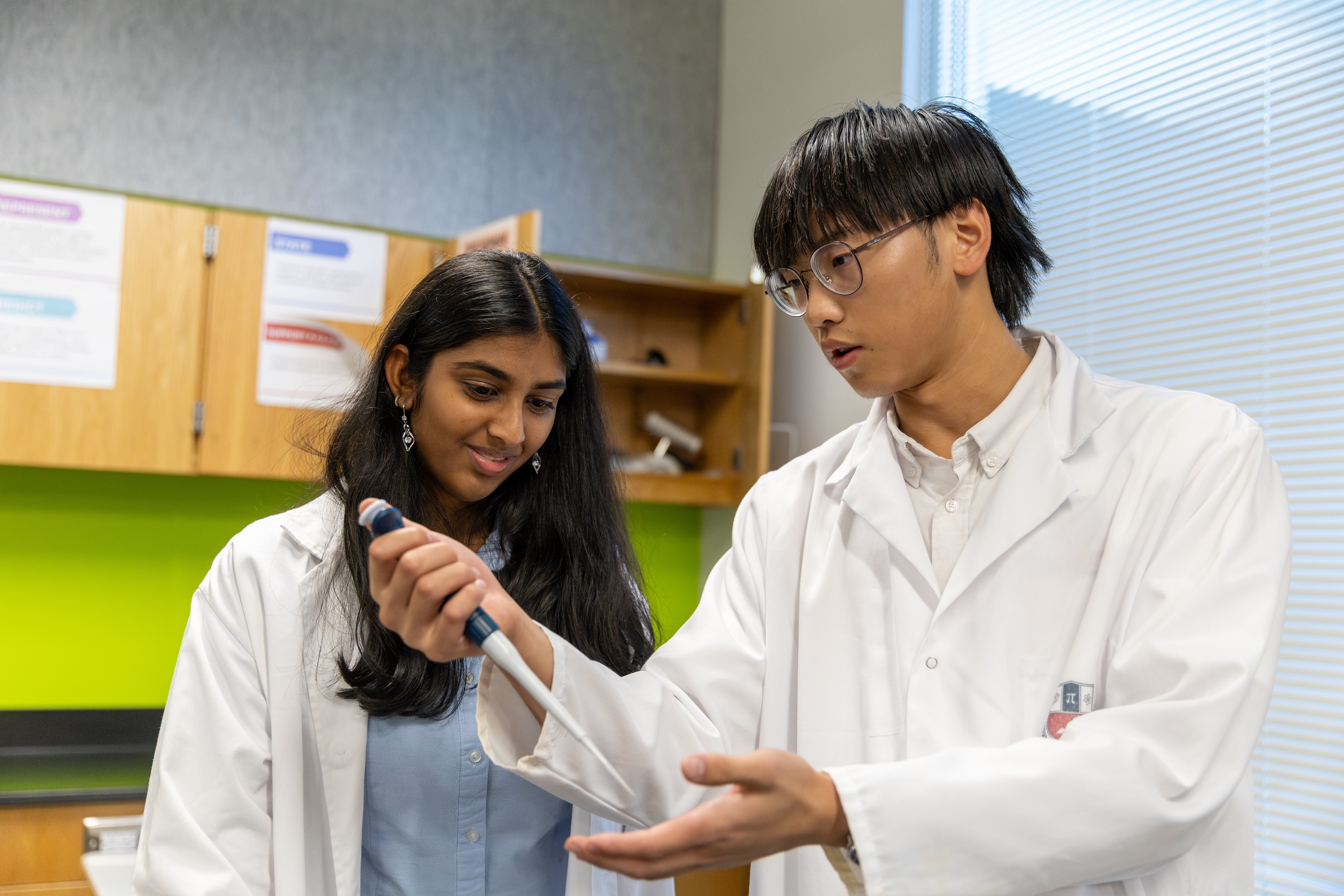
At Fulton Science Academy, one of our I-CARE core values is curiosity, and in my classroom, I do not simply hope students will develop it; I intentionally design for it. As a teacher of Honors Biology and AP Environmental Science, I have found that the most meaningful learning happens when students are actively engaged in the process of doing science rather than passively memorizing information. While content knowledge is certainly important, my primary goal is to help students think like scientists by asking questions, solving problems, and applying their learning to real-world situations.
.jpeg)
At Fulton Science Academy, one of our I-CARE core values is curiosity, and in my classroom, I do not simply hope students will develop it; I intentionally design for it. As a teacher of Honors Biology and AP Environmental Science, I have found that the most meaningful learning happens when students are actively engaged in the process of doing science rather than passively memorizing information. While content knowledge is certainly important, my primary goal is to help students think like scientists by asking questions, solving problems, and applying their learning to real-world situations.
In many traditional educational systems, there is often a strong emphasis on memorization and content acquisition. While this approach can certainly build a solid knowledge base, I strive to go a step further by focusing on skill development, critical thinking, and student-centered learning. I want my students to understand not just what science is, but how science works.
One of the most engaging projects I implemented this year in Honors Biology was the “Zombie Apocalypse Cell City” project. Instead of having students memorize the functions of organelles, I challenged them to design a model of a cell as a functioning city facing crisis scenarios. Students were assigned real-world analogies for each organelle, such as the nucleus acting like city hall or mitochondria serving as power plants. The twist was that their “cell city” was under attack from a simulated zombie outbreak, representing a breakdown in homeostasis and a compromised cell membrane.
Students were tasked with developing solutions to protect the cell and maintain stability. This project naturally integrated STEAM elements, as students combined scientific understanding with engineering design, creative expression, and technology tools like Canva and Google Slides. More importantly, students quickly realized that a cell is not just a collection of parts but a dynamic system in which each component plays a critical role. When one part fails, the entire system is affected.
What made this project particularly powerful was that not every design worked on the first attempt. Students had to revise, adapt, and improve their models in response to feedback. This process emphasized iteration and resilience, helping students understand that failure is not something to avoid but an essential part of learning. In many ways, this mirrored the authentic work of scientists, who constantly test, refine, and rethink their ideas.
In AP Environmental Science, I took a similar approach with the Climate Crisis Solutions Project. Rather than simply learning about global climate change through lectures and readings, students selected from a wide range of real-world environmental issues and investigated them in depth. Using resources such as Mr. Smedes’ APES lectures, students analyzed data, explored case studies, and developed actionable solutions to pressing global problems.
Students were given the freedom to choose how they communicated their findings, whether through podcasts, videos, infographics, policy briefs, or presentations. This level of choice increased engagement and allowed students to take ownership of their learning. More importantly, it shifted their role from passive learners to active problem-solvers. They were no longer just studying climate change; they were thinking like environmental scientists, policymakers, and advocates.
Across both courses, I emphasize the importance of feedback, revision, and iteration. Students are encouraged to refine their work and deepen their understanding over time. This reflects the true nature of science, which is not a linear process but an ongoing cycle of questioning, testing, and improving. By creating an environment where revision is expected and valued, students become more willing to take intellectual risks and engage more deeply with the material.
Ultimately, my goal is to move students beyond memorization and toward meaningful understanding. I want them to ask better questions, make connections between concepts, and apply their knowledge in new and unfamiliar contexts. Science education should not be about recalling isolated facts; it should be about developing the skills and mindset needed to navigate complex, real-world challenges.
Whether students are defending a “cell” city from a fictional zombie outbreak or proposing solutions to global climate change, the objective remains the same. I want them to see themselves not just as students learning science, but as individuals capable of thinking, questioning, and contributing like scientists. When that shift happens, curiosity is no longer something I have to encourage; it becomes something that naturally drives their learning forward.
Author Biography
Kevin McKinley is finishing his second year as part of the Fulton Science Academy family, where he brings a passion for science, curiosity, and real-world experience into the classroom. Originally from Fitzgerald, Georgia, he has built a diverse academic and professional background that shapes his approach to teaching. He holds degrees in biochemistry from Mercer University and marine science from Clemson University, as well as additional training in behavioral science and health education from Emory University.
His career has taken him from working in DNA sequencing at the CDC and Emory University to serving as a microbiologist in an Atlanta-area hospital. He then spent 16 years at the Georgia Aquarium as an environmental educator, where he had the privilege of inspiring thousands of students through hands-on marine science experiences.
In addition to his classroom teaching experience at Atlanta Academy and Fulton Academy of Science and Technology, where he was honored as Middle School Teacher of the Year (2022–2023), he is deeply committed to creating engaging, inquiry-based lessons that spark curiosity and foster a love of learning. He believes science education should be both intellectually rigorous and genuinely exciting.
At Fulton Science Academy, he teaches Honors Biology and AP Environmental Science and also serves as an advisor for Science Olympiad (Water Quality), the Science National Honor Society, HOSA, and MDJunior. Outside of school, he enjoys spending time with his family, exploring the outdoors, scuba diving, and traveling—especially anywhere near the ocean.