
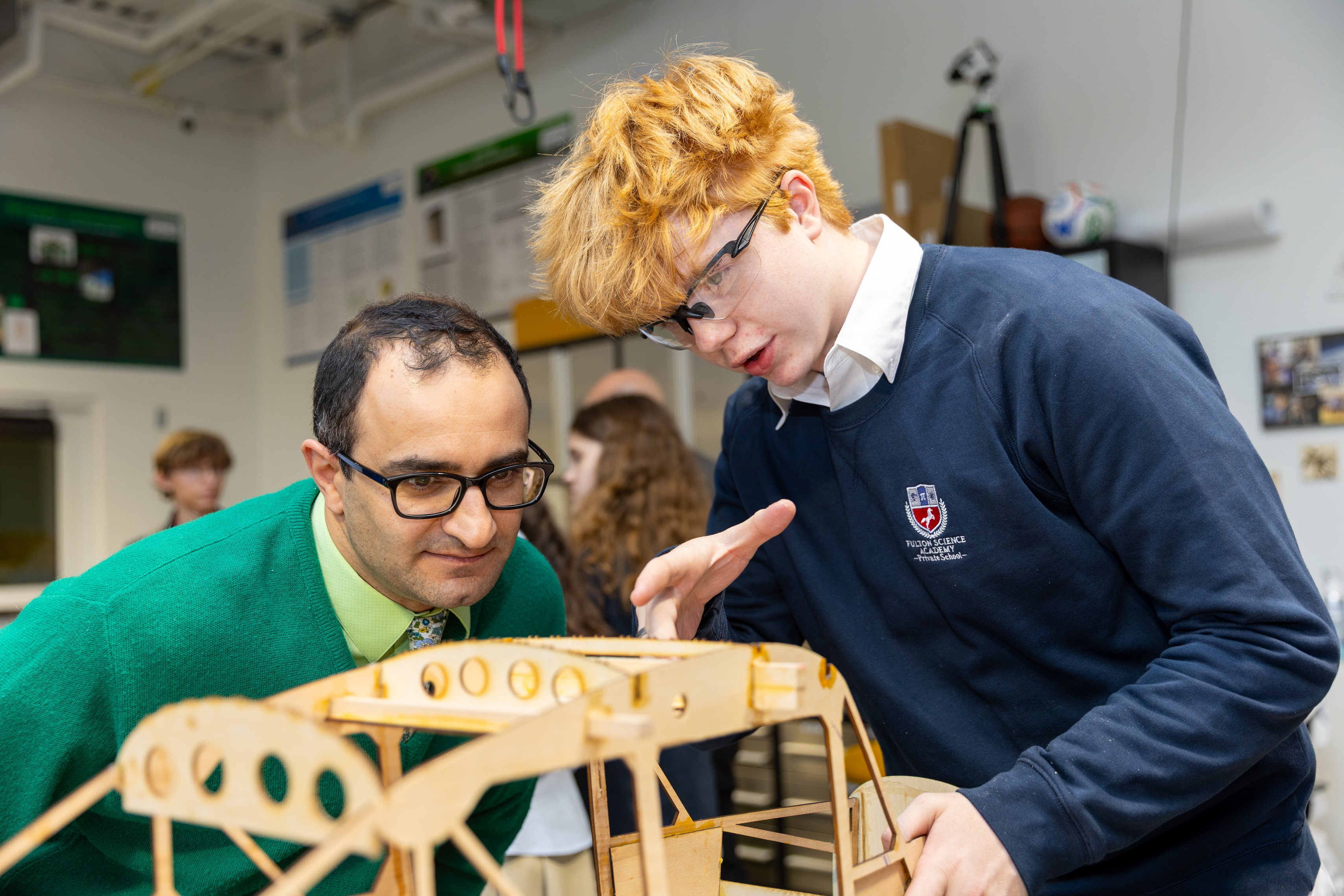

At the Astronomy Society of Fulton Science Academy (ASFSA), students don’t just study science—they live it. They design and build satellites, develop CubeSat missions, and have partnered with Interstellar Technologies, a Japanese launch company, to send their first satellite into orbit in 2027. Their hands-on work extends from engineering and motorizing a custom-built Dobsonian telescope to designing and testing model rockets that reach precise altitudes and durations. Through every experiment and mission, ASFSA students integrate physics, engineering, and data analysis—transforming classrooms into laboratories of real-world discovery.

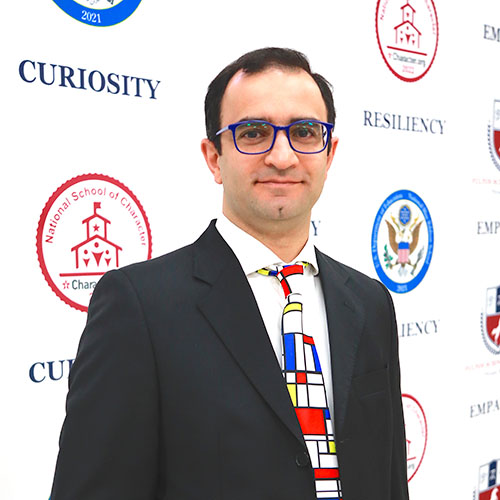
Written by Dr. Ramin Ahmadoghlu Adams
At the Astronomy Society of Fulton Science Academy (ASFSA), students don’t just study science—they live it. They design and build satellites, develop CubeSat missions, and have partnered with Interstellar Technologies, a Japanese launch company, to send their first satellite into orbit in 2027. Their hands-on work extends from engineering and motorizing a custom-built Dobsonian telescope to designing and testing model rockets that reach precise altitudes and durations. Through every experiment and mission, ASFSA students integrate physics, engineering, and data analysis—transforming classrooms into laboratories of real-world discovery.
Inside FSA’s Innovation Lab, students use advanced fabrication tools such as CNC mills and laser cutters to design and produce components for their missions. Beyond the lab, they publish research in Scripta, the school’s peer-reviewed student research journal, and present at academic and professional conferences, engaging directly with scientists and peers.
How does all this happen within a high school setting? How do students transcend the traditional boundaries of secondary education? The answer lies in ASFSA’s educational philosophy, which challenges conventional notions of schooling and creates an environment where students are empowered to question, innovate, and transform. What sets ASFSA apart is its living philosophy of transformative agency—a model of learning in which students move beyond participation and begin to reshape the very structures of their education.
What Is Transformative Agency?
The idea of transformative agency comes from educational theorist Yrjö Engeström, who proposed that genuine learning occurs when individuals and communities expand and redesign their systems of activity. Rather than adapting to routines, learners take initiative to change them. In simple terms, transformative agency emerges when students are trusted to take ownership of authentic, meaningful work, and, in doing so, transform both themselves and their learning environment. It’s not about following instructions; it’s about inventing new possibilities. It’s the difference between a student who learns about satellites and one who builds one; between studying astronomy and discovering the cosmos firsthand.
The Philosophy Behind Transformative Agency
Transformative agency rests on several interconnected ideas. It begins with trust—learning flourishes when students are given real responsibility, allowing curiosity to evolve into accountability. Purpose follows, as students who understand why their work matters develop intrinsic rather than imposed motivation. Collaboration is essential because agency grows in a community where learners co-create knowledge and share expertise across disciplines and grade levels. Reflection deepens the process by encouraging students to question assumptions, analyze systems, and continually improve their practices. Finally, authenticity grounds the entire experience: working with real tools, real data, and real consequences makes learning meaningful and lasting. At its heart, this philosophy views education not as the transfer of knowledge but as the construction of capability and identity. Students don’t learn for life; they learn as scientists, engineers, and explorers already living it.
Transformative Agency at Work: FSA’s Small Satellite Program
ASFSA’s Small Satellite Research and Development Program (SSRDP) is a clear example of transformative agency in action. Students design, prototype, and test a functioning CubeSat, KorucuSAT, in collaboration with university research labs and aerospace engineers. They write code, design circuits, and model orbital trajectories, tackling tasks that many students encounter only in graduate school. More importantly, they work collaboratively, holding subsystem meetings, documenting progress, and presenting to professional mentors. In doing so, they are not just learning aerospace engineering—they’re redefining what high school research can be. They’ve transformed the boundary between “student” and “scientist” into a continuum of shared discovery.
From the Ground to the Sky
Transformative agency doesn’t stop at orbit. In ASFSA’s observatory and astrophotography lab, students operate professional-grade telescopes and imaging systems to capture galaxies, nebulae, and solar phenomena. When they built and motorized their Dobsonian telescope themselves, they learned not only optics and mechanics but also craftsmanship and perseverance. Constructing an instrument from raw materials transforms their relationship with science, shifting from consuming technology to creating it.
Tools, Labs, and the Power of Trust
A defining feature of ASFSA’s culture is that students have access to the real tools of science and engineering. Inside the Innovation Lab, they operate the Tormach 1500MX CNC mill, 3D printers, laser cutters, and precision instruments for satellite component fabrication. This access is not symbolic—it is structural trust. Students are taught safety and design principles, then trusted to take charge. That trust transforms behavior: responsibility replaces supervision, and initiative replaces instruction. The lab becomes a workshop of autonomy where mistakes are seen as learning opportunities, not failures.
Scripta: Research as a Rite of Passage
Scientific discovery isn’t complete until it’s shared. ASFSA’s peer-reviewed student research journal, Scripta, provides that platform. Students serve as editors, reviewers, and authors—learning the ethics, rigor, and discipline of academic publishing. Through Scripta, they experience the full research cycle: inquiry, experimentation, writing, critique, and dissemination. This process turns classroom learning into scholarly contribution and reinforces a culture where knowledge is built, debated, and refined.
Collaboration as the Engine of Innovation
Transformative agency is inherently social. Whether working on a CubeSat, aligning a telescope, or editing a journal article, ASFSA students learn that progress happens through collaboration. Teams are intentionally interdisciplinary; engineers work with researchers, designers with analysts, and younger students learn from older mentors. This mirrors real scientific communities, where collaboration drives both accountability and creativity.
Transforming Education, Not Just Students
Through its integrated ecosystem of projects—satellite development, space exploration and astrophotography program, research publication, and access to professional tools—ASFSA has built a culture where learning equals invention. Students are not preparing for the future; they are building it now. They have become active agents of their own education, reshaping what a high school science program can be. In the language of Engeström, ASFSA has achieved expansive learning—where the system evolves because its participants dare to imagine more.
When a student points a telescope toward the stars, machines a satellite panel, or edits a peer’s research article, they are doing more than learning skills; they are embodying the philosophy that defines ASFSA. Education, in this setting, is not preparation for life; it is the practice of growing as a scientist. That is the power of transformative agency, and at Astro FSA, it’s happening every day.
Author Biography
Dr. Ramin Ahmadoghlu Adams is the Student Research Programs Director at Fulton Science Academy, where he leads initiatives that integrate innovation, technology, and authentic research into K–12 education. He earned his Ph.D. from the University of Cincinnati, later teaching there and at Georgia Gwinnett College, before completing a postdoctoral fellowship at Emory University. At FSA, he founded the Small Satellite Research and Development Program and several student journals, fostering a culture of inquiry and creativity that transforms students into scientists, engineers, and inventors.